#AGS Coir
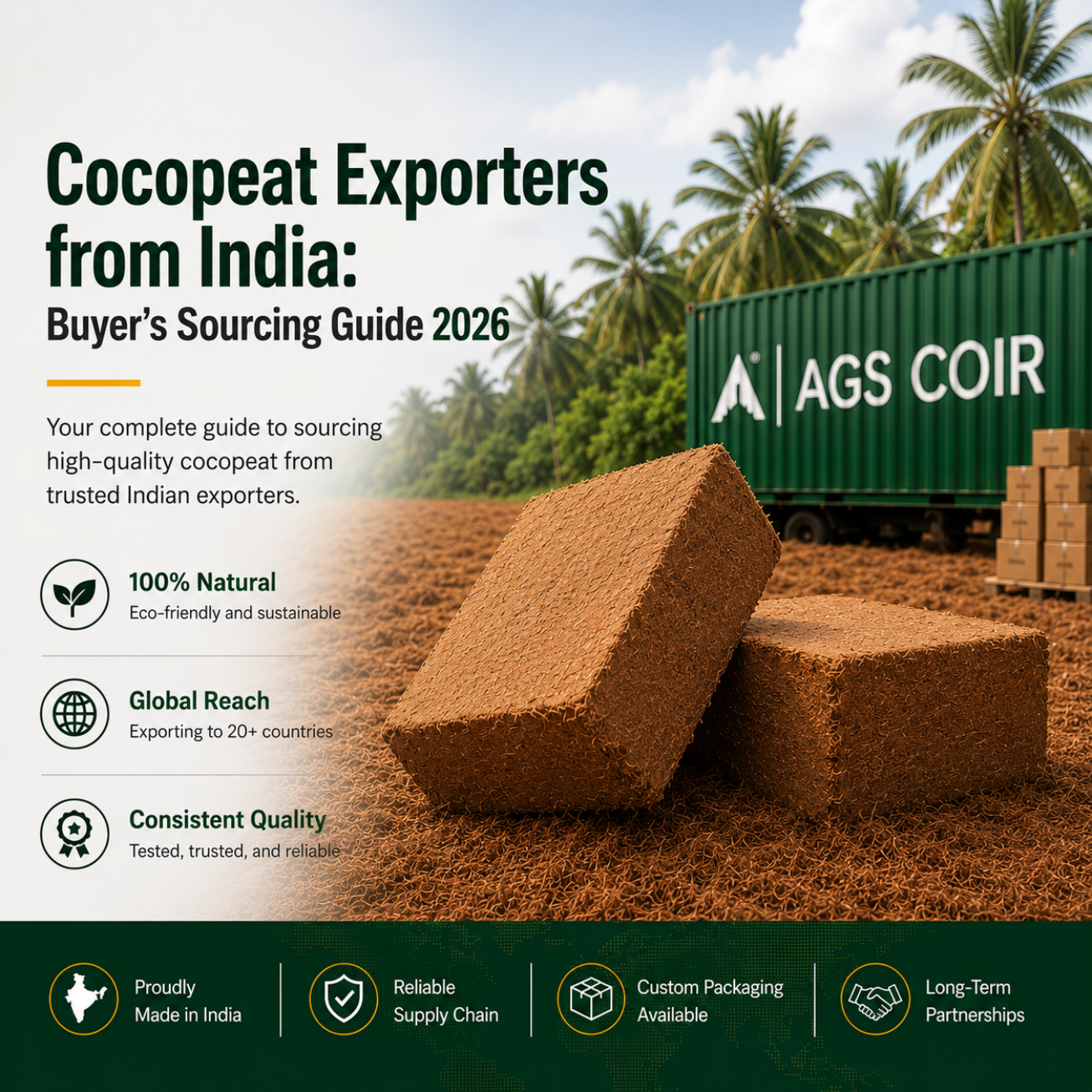
Cocopeat Exporters from India: Buyer's Sourcing Guide 2026 | Coir Board Registered
The United Kingdom is banning horticultural peat in 2026. Europe is scrambling to replace it. And Indian cocopeat exporters are the ones filling the gap.
That's one headline driving demand right now. But it's just one. Global cocopeat exports from India recovered strongly in 2024, reaching $321.28 million - and early FY26 data (April–July 2025) shows coir product exports up 62.86% year-on-year, the strongest growth rate in years.
If you're sourcing cocopeat for agriculture, hydroponics, horticulture, or commercial greenhouse operations, an Indian exporter is almost certainly your best option. The raw material, processing infrastructure, and price point are unmatched globally.
The challenge is choosing the right one. There are hundreds of exporters in Tamil Nadu alone - and they all say the same things. "Premium quality." "Best price." "Timely delivery." "ISO certified."
This guide cuts through that noise. It tells you which product formats to order, which quality parameters to specify, how to verify an exporter before wiring money, and which markets are growing fastest right now.
Why India Dominates the Global Cocopeat Market in 2026
India's dominance isn't a trend - it's structural.
India accounts for more than 52,987 recorded cocopeat shipments globally, ahead of Sri Lanka (14,306) and China (3,324) by a wide margin. The country accounts for over 30% of global cocopeat production, with Tamil Nadu, Kerala, Karnataka, and Andhra Pradesh as the primary producing states.
Three things keep India at the top:
Raw material advantage. India is one of the world's largest coconut producers. Coconut husks - the raw material for cocopeat - are available in enormous volumes at low cost, particularly in Tamil Nadu's Pollachi, Coimbatore, and Madurai belts.
Processing maturity. Indian exporters have shifted rapidly from basic sun-drying to precision-processing: buffered, washed, and triple-sieved cocopeat with certified EC and pH levels. Buyers who sourced from India five years ago will find a meaningfully better product today.
Coir Board oversight. The Coir Board of India, a Government of India body, regulates and promotes coir exports. This provides standardized quality benchmarks and export accountability that simply don't exist to the same degree in competing countries.
The 2026 macro picture adds fuel. The UK peat ban is redirecting European buyers toward sustainable alternatives - and cocopeat is the primary beneficiary. The Netherlands, Germany, and the UK are already major consumers in floriculture and horticulture. That pipeline is growing.
What's New in 2026: Market Shifts Every Buyer Should Know
Before you source, understand where the market is moving. Three shifts are reshaping trade flows right now.
1. Africa Is the Fastest-Growing Import Region
Africa's cocopeat market is projected to grow at 8.3% market share in 2026, driven by greenhouse expansion and government-backed sustainable farming programs in South Africa, Kenya, and Morocco. This is an emerging region - pricing is less competitive than established markets - but it signals where Indian exporters are building new capacity.
2. Brazil and South America Are Breaking Out
Brazil became the leading Indian cocopeat importer in 2025 by value, driven by its expanding commercial agriculture sector. Peru had already posted 281.8% import value growth in 2024. If your exporter doesn't have South American experience, ask why.
3. The Hydroponics Upgrade Is Real
The fastest-growing product format globally is no longer the 5 kg block - it's buffered, low-EC cocopeat specifically processed for hydroponic and vertical farming applications. European and North American buyers are increasingly demanding pre-buffered substrate, not raw compressed peat. If you're in this segment, your quality specifications need to reflect it.
Why European Buyers Are Switching to Indian Cocopeat in 2026
In November 2022, the UK Government confirmed a ban on the sale of horticultural peat to amateur gardeners by 2024, with a full professional-use ban planned for 2026. The implementation timeline has shifted slightly - but the direction hasn't. The UK peat ban is the biggest structural demand shift in the European growing media market in a generation.
Peat has been the default substrate for UK and European professional horticulture for decades - used in potting mixes, nursery production, mushroom cultivation, and large-scale greenhouse operations. Replacing it requires an alternative that matches peat's key properties: high water retention, good aeration, stable pH, and low contamination risk. Cocopeat matches all four.
The Netherlands was already the third-largest importer of Indian cocopeat globally in 2024 at $27.8 million. Germany and the UK follow. As the ban bites harder in 2026, European procurement managers who previously treated cocopeat as a secondary option are now treating it as their primary substrate.
What this means for buyers:
- Lead times are tightening. European demand is rising faster than processing capacity can scale. If you're a European buyer placing orders for the first time, expect 4–6 week lead times minimum, and build buffer stock accordingly.
- Low EC and buffered grades are what Europe needs. Professional European horticulture - particularly floriculture and food-crop greenhouse operations - requires low EC (below 0.5 mS/cm), consistent particle sizing, and in many cases, OMRI or EU Organic equivalent certification. Standard high-EC blocks are not a substitute.
- Supplier verification matters more now. Opportunistic processors enter the market whenever demand spikes. The six-step verification checklist in this guide applies doubly for European buyers, who face stricter import quality controls and have less tolerance for a non-conforming shipment.
For Indian exporters, the UK peat ban is the clearest long-term demand signal the cocopeat industry has seen. For European buyers, it's a sourcing urgency - and the window to establish reliable supply relationships before the market gets crowded is narrowing.
Cocopeat Product Formats: What to Order and Why
Know what you need before you contact any exporter. Ordering the wrong format costs money on every shipment.
5 kg Compressed Blocks
The standard bulk export format. Each block expands to approximately 70–75 litres of loose cocopeat when hydrated - a 5:1 compression ratio. Palletized and stretch-wrapped for container loading. The default for large-scale agricultural and horticultural buyers.
650g Briquettes (Bricks)
Preferred for retail markets - garden centers, online sellers, and nurseries that repackage into consumer units. Lighter, easier to handle, and better suited for end-user applications.
Coco Grow Bags
Pre-filled grow bags for hydroponic systems - tomatoes, cucumbers, capsicum, strawberries, roses. Sizes vary by crop type. Increasingly requested by European and Middle Eastern controlled-environment agriculture buyers.
Buffered / Pre-Washed Loose Cocopeat
The premium-tier product. Pre-washed, triple-buffered, and sieved to specification. Supplied in bulk bags. Used by substrate manufacturers, professional growing media producers, and high-end hydroponic operators who can't tolerate EC variation between batches.
The Quality Parameters That Actually Matter
This is where most buyers go wrong. They ask for "good quality cocopeat" without specifying parameters - and receive a product that fails their application.
Specify these four numbers in every purchase order:
Electrical Conductivity (EC)
EC measures dissolved salt content in the cocopeat. It is the single most important quality parameter - and the one most buyers underspecify.
| Grade |
EC Range |
Ideal Use Case |
Typical Crops |
Certification Often Required |
| Low EC |
Below 0.5 mS/cm |
Hydroponics, seedling propagation, sensitive crops |
Tomato, cucumber, strawberry, rose, lettuce |
OMRI (US/Canada), EU Organic (Europe) |
| Medium EC |
0.5–1.0 mS/cm |
General horticulture, potting mixes, nursery stock |
Mixed vegetables, ornamentals, herbs |
ISO 9001 sufficient for most markets |
| High EC |
Above 1.0 mS/cm |
Open-field soil amendment, land conditioning |
Field crops, landscaping, turf |
None typically required |
| Buffered |
Below 0.5 mS/cm (post-rinse verified) |
Professional substrate manufacturing, precision hydroponics |
High-value greenhouse crops, floriculture |
OMRI / EU Organic; third-party lab batch testing |
Coconut husks naturally absorb salts during processing - sometimes from ocean proximity, sometimes from the water used in retting. Thorough washing removes them. Don't assume low EC without a certificate from the specific batch you're purchasing.
Ask for a third-party EC test certificate. Reputable exporters produce these without hesitation. A supplier who pushes back on this request is a red flag.
pH Level
Target range for plant growth: 5.5 to 6.5. Cocopeat naturally falls here, but poor processing or contaminated water can push it outside the window. Request the pH report alongside the EC certificate - both should come from the same lab test batch.
Moisture Content
Export-grade cocopeat must be below 10-15% moisture at the time of shipping. Above that, you pay more freight weight and risk fungal development during transit. Verify this on your pre-shipment inspection report.
Particle Size / Grade
- Fine grade: Seed germination, seedling trays, propagation
- Medium grade: General potting mixes, container gardening
- Coarse grade / Coco chips: Hydroponics, orchids, aeration-heavy substrates
Specify your required grade in writing. Without it, you get whatever the exporter has in stock.
Sourcing cocopeat for the first time?
AGS Coir sends free 500g samples to verified buyers. Coir Board registered. Ships to 20+ countries.
Request a Free Sample →
There are genuine, large-scale Indian exporters who ship reliably to 20+ countries. And there are small processors who export opportunistically with no consistency controls. Here's how to tell them apart before you pay.
Step 1: Check Coir Board RCMC Registration
The Coir Board of India issues a Registration-cum-Membership Certificate (RCMC) to registered exporters. A legitimate exporter will share it immediately. If they don't have one, they are likely not a registered coir exporter.
Step 2: Verify Their Import Export Code (IEC)
Every legal Indian exporter has an IEC issued by the Directorate General of Foreign Trade (DGFT). The number is publicly verifiable on the DGFT portal. Cross-check it. Takes two minutes and confirms the business is legally registered for export.
Step 3: Request Third-Party Lab Test Reports
Ask for recent reports from SGS, Intertek, Bureau Veritas, or an accredited Indian testing lab. The report must cover EC, pH, moisture content, and particle size. If an exporter cannot produce this, move on.
Step 4: Commission a Pre-Shipment Inspection
For your first order, hire a third-party inspector - SGS and Intertek both operate across Tamil Nadu and Kerala - to physically inspect goods before container loading. Cost: typically $150–$300. Negligible against the cost of a non-conforming container.
Step 5: Pull Their Shipment History
Trade data platforms - Volza, Seair Exim Solutions, Panjiva - let you pull actual export shipment records by company name. You can see who they have shipped to, how frequently, and in what volumes. This is the most objective signal of a genuinely active, experienced exporter. An exporter with 50+ shipments to multiple countries is far lower risk than one with 3.
Step 6: Confirm Certifications for Your Destination Market
- OMRI Listed: Required for certified organic applications in the US and Canada
- ISO 9001: Quality management system certification
- Phytosanitary Certificate: Mandatory for all shipments globally; issued by India's Plant Quarantine Department
- Fumigation Certificate: Required by most importing countries
Export Documents Required for Every Shipment
Your exporter is responsible for producing these. If they're unfamiliar with any of them, that is a serious competency concern.
- Commercial Invoice and Packing List
- Bill of Lading (or Airway Bill for air freight)
- Shipping Bill
- Phytosanitary Certificate (Plant Quarantine Department, India)
- Certificate of Origin
- Fumigation Certificate
- Quality / Lab Test Report (buyer-specified)
US-specific: USDA-APHIS compliance documentation required. EU/UK organic buyers: OMRI or equivalent organic certification required. Australia: DAFF (Department of Agriculture, Fisheries and Forestry) import conditions apply.
Confirm your destination country's full import requirements before placing your order.
Top Import Markets for Indian Cocopeat in 2026
A strong exporter ships to multiple destinations. If a supplier claims to export globally but their shipment history shows only one or two markets, investigate further.
Established high-volume markets (2024 data):
| Country |
Import Value |
Notes |
| China |
$95.99 million |
Largest single importer |
| United States |
$47.4 million |
27,077 shipments recorded |
| Netherlands |
$27.8 million |
Gateway to wider European distribution |
| South Korea |
— |
10,197 shipments; stable long-term buyer |
High-growth markets to watch in 2026:
| Country/Region |
Growth Signal |
Driver |
| Brazil |
#1 importer by value in 2025 |
Commercial agriculture expansion |
| Peru |
281.8% import value growth (2024) |
Agri-sector scaling |
| Canada |
63.4% growth (2024) |
Greenhouse horticulture expansion |
| UAE / Saudi Arabia |
46.5% growth (2024) |
Vertical farming investment |
| Africa (Kenya, Morocco, S. Africa) |
8.3% regional share projected (2026) |
Greenhouse adoption + sustainability mandates |
| UK / Germany |
New 2026 tailwind |
UK peat ban driving substrate substitution |
Pricing: What to Expect per Container in 2026
Not fixed prices. Actual figures depend on order volume, grade, destination port, and market conditions at time of order.
A standard 40-foot high-cube container holds approximately 20–23 MT of compressed cocopeat blocks. Many exporters offer CIF (Cost, Insurance, Freight) pricing - bundling shipping and insurance to your destination port. For first-time importers, CIF simplifies budgeting and reduces logistics coordination burden.
Container freight rates from Indian ports (Chennai, Tuticorin, Cochin) fluctuate with season and demand. Plan for freight cost reviews in any long-term supply agreement.
Common Sourcing Mistakes to Avoid
Accepting "good quality" without specifying EC levels. Low-EC and high-EC cocopeat look identical in a photograph. One can destroy a hydroponic crop. Specify EC in writing on every order.
Skipping the sample step. Request a physical sample before committing to a container. Any reputable exporter sends samples at no charge. Run your own lab test on receipt.
Ordering without a written supply agreement. A proforma invoice is not a contract. Define EC range, pH range, moisture limit, particle grade, packaging spec, loading timeline, and what happens if the shipment is non-conforming.
Choosing on price alone. The cheapest quote often reflects the lowest grade - poorly washed, high EC, inconsistent particle size. The gap between a good and bad container can be far larger than the price difference.
Treating every order as spot. Consistent quality comes from supplier relationships, not spot sourcing. Negotiate quarterly or annual supply agreements with verified exporters. You get better pricing, priority loading windows, and meaningful accountability.
From the Field: What a Real Sourcing Switch Looks Like
A buyer we onboarded in Q3 2025, sourcing for a closed hydroponic operation in Rotterdam, This buyer had been sourcing cocopeat from a different Indian exporter for two years. The product passed initial lab tests - EC was below 0.5 mS/cm on the sample - but showed inconsistency between pallets within the same container. Some blocks came in at 0.8 mS/cm or above. In a closed hydroponic system, that variance is enough to stress plants and suppress yield during the first weeks of the growing cycle.
The documentation was also a recurring issue. Phytosanitary certificates were arriving after the shipment in several cases, creating customs hold-ups at Rotterdam that delayed production scheduling by 10–14 days per order.
They switched suppliers and specified three non-negotiables in the contract: batch-level EC certification (not sample-level), pre-shipment inspection by Bureau Veritas, and a documentation delivery deadline of 5 days before vessel departure. The first container under the new agreement came in with EC uniformly below 0.4 mS/cm across all pallets - verified independently on arrival. No customs delays in the first two shipments.
FAQ: Cocopeat Exporters from India (2026)
Q1. What is the HS code for cocopeat export from India in 2026?
The primary HS codes are 53050040, with some shipments also classified under 14049099 and 14049000 depending on product form and destination country requirements. Confirm the correct code with your customs broker before shipment.
Q2. Which Indian states produce the best cocopeat?
Tamil Nadu is the largest producing and exporting state - particularly the Pollachi, Coimbatore, Madurai, and Tuticorin corridors. Kerala and Andhra Pradesh are also significant. Tamil Nadu's proximity to the ports of Chennai and Tuticorin gives it a meaningful logistics advantage over inland producers.
Q3. What is the difference between Low EC and High EC cocopeat, and which do I need?
EC (Electrical Conductivity) measures dissolved salt content. Low EC cocopeat (below 0.5 mS/cm) has been thoroughly washed and is required for hydroponics, seedling propagation, and most export markets with quality mandates. High EC cocopeat suits open-field soil amendment where existing soil dilutes the salts. If you're unsure which you need, your agronomist or growing media specialist can advise based on your crop and system type.
Q4. How long does shipping from India take in 2026?
Typical sea transit times from Chennai or Tuticorin: US East Coast 18–25 days; Rotterdam / UK 20–28 days; Australia / New Zealand 12–18 days; UAE 6–10 days. Add 7–14 days for production and container loading. Plan your inventory buffer accordingly, especially around India's monsoon season (June–September) when loading schedules can shift.
Q5. Is Indian cocopeat organic certified, and what certification do I need?
Not all Indian cocopeat is certified organic - but many exporters carry OMRI (Organic Materials Review Institute) certification, which is the standard for use in certified organic growing in the US and Canada. In Europe, look for EU Organic equivalent certifications or country-specific requirements. Always verify the certificate number independently before relying on it for compliance.
About the Author
AGS Coir — Aravind Global Sourcing Private Limited
This guide is written by AGS Coir, a Coir Board registered cocopeat exporter based in Madurai, Tamil Nadu (IEC registered, DGFT verified). We export cocopeat blocks, briquettes, grow bags, and loose buffered substrate to buyers across the Netherlands, USA, UAE, and 10+ countries. All quality data in this guide is drawn from our own processing and export experience.
Request a sample or get a quote →